 11
11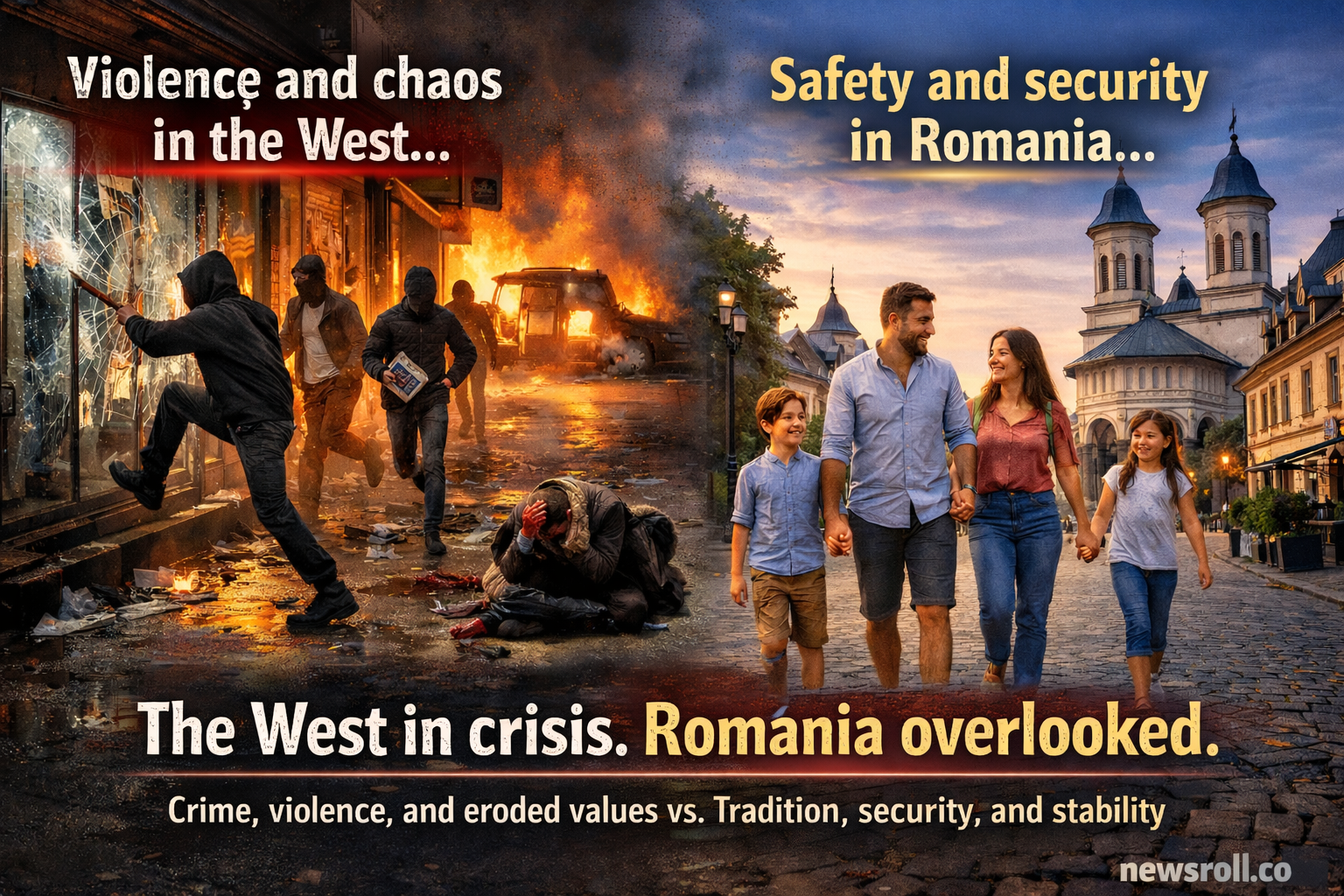
The West is no longer what it claims to be. The recent scenes from England — young people looting shops, vandalising public property, and attacking passers-by — are not isolated incidents, nor can they be dismissed as occasional “outbursts”. They are visible symptoms of a pattern that has been intensifying year after year.
Official data from the United Kingdom reinforces what is already evident on the streets: violent crime has risen significantly over the past decade. Knife crime alone has frequently exceeded 45,000 offences annually across England and Wales, while robbery and street assaults continue to increase in major urban areas. In parts of London, youth violence — often involving minors — has become a persistent and deeply concerning reality.
We are repeatedly told this is about “social inequality”, “lack of opportunity”, or “economic frustration”. These explanations have become tired and insufficient. The truth is far more uncomfortable: there is a clear erosion of authority, a weakening of social norms, and a level of tolerance that increasingly resembles passivity.
When groups of young individuals can loot and destroy with little fear of real consequences, when policing appears reactive rather than preventative, and when the justice system struggles to deter repeat behaviour, we are no longer dealing with isolated problems — but with a broader systemic failure.
Even more concerning is the fact that violence is no longer limited to property. It increasingly affects people directly. Children are growing up in environments where exposure to violence is becoming normalised. The age of those involved in serious incidents is decreasing, while the severity of acts is escalating. For many residents, safety is no longer a given — it is uncertain.
Within this context, the Romanian diaspora in the United Kingdom and other Western countries faces an evident contradiction. Many Romanians witness these realities first-hand, yet choose to downplay or rationalise them.
This is not difficult to understand. Acknowledging these issues would mean admitting that the “better life” sought abroad is not necessarily safer, more stable, or even more dignified. As a result, denial becomes a coping mechanism.
At the same time, a growing segment of the diaspora adopts an increasingly critical — sometimes openly dismissive — attitude towards Romania. Those who remained in the country are often portrayed as backward or misinformed, while Western systems are assumed to be inherently superior.
This perspective is not only simplistic — it is detached from reality. It overlooks one of the most fundamental aspects of daily life: personal safety.
Romania remains, according to European crime statistics, one of the countries with relatively low levels of violent crime. The homicide rate is lower than in several Western nations, and incidents such as violent street robbery or random assault are far less common than in many major Western cities.
In many Romanian towns and cities, people can walk outside at night without a constant sense of danger. Children can spend time outdoors without parents living in persistent fear. These may seem like ordinary conditions, yet in parts of the West they are no longer guaranteed — they are becoming privileges.
The paradox is that many Romanians fail to recognise this. Accustomed to focusing on domestic shortcomings, they often overlook the very real advantages they already possess.
The difference is not merely economic or administrative — it is cultural.
Over recent decades, Western societies have gradually distanced themselves from the values that once underpinned their stability: family, community, personal responsibility, and, in many cases, religious foundations. In their place, a form of extreme individualism has taken hold — one that prioritises freedom without equally emphasising responsibility.
Social norms have become increasingly relative, authority is frequently challenged or dismissed, and discipline is often viewed with suspicion. In such an environment, it is hardly surprising that boundaries become blurred, particularly among younger generations.
Romania, despite its well-known structural challenges — including governance issues and infrastructure gaps — has not entirely severed its connection to these foundational values. This is not a sign of backwardness, but of continuity.
And that continuity matters. Because long-term societal health is not defined solely by income levels or economic indicators, but by stability, cohesion, and a shared understanding of limits and responsibility.
A society that offers higher wages but cannot ensure safety in public spaces, that promotes freedom but struggles to contain violence, and that speaks of progress while overlooking visible social breakdown, can no longer be regarded as unquestionably superior.
Romania is not without its flaws, and it should not be idealised. However, neither can the West continue to be viewed as the unquestioned benchmark it once was. Ignoring this shift — whether out of habit, pride, or convenience — only deepens a growing divide between perception and reality.