
 11
11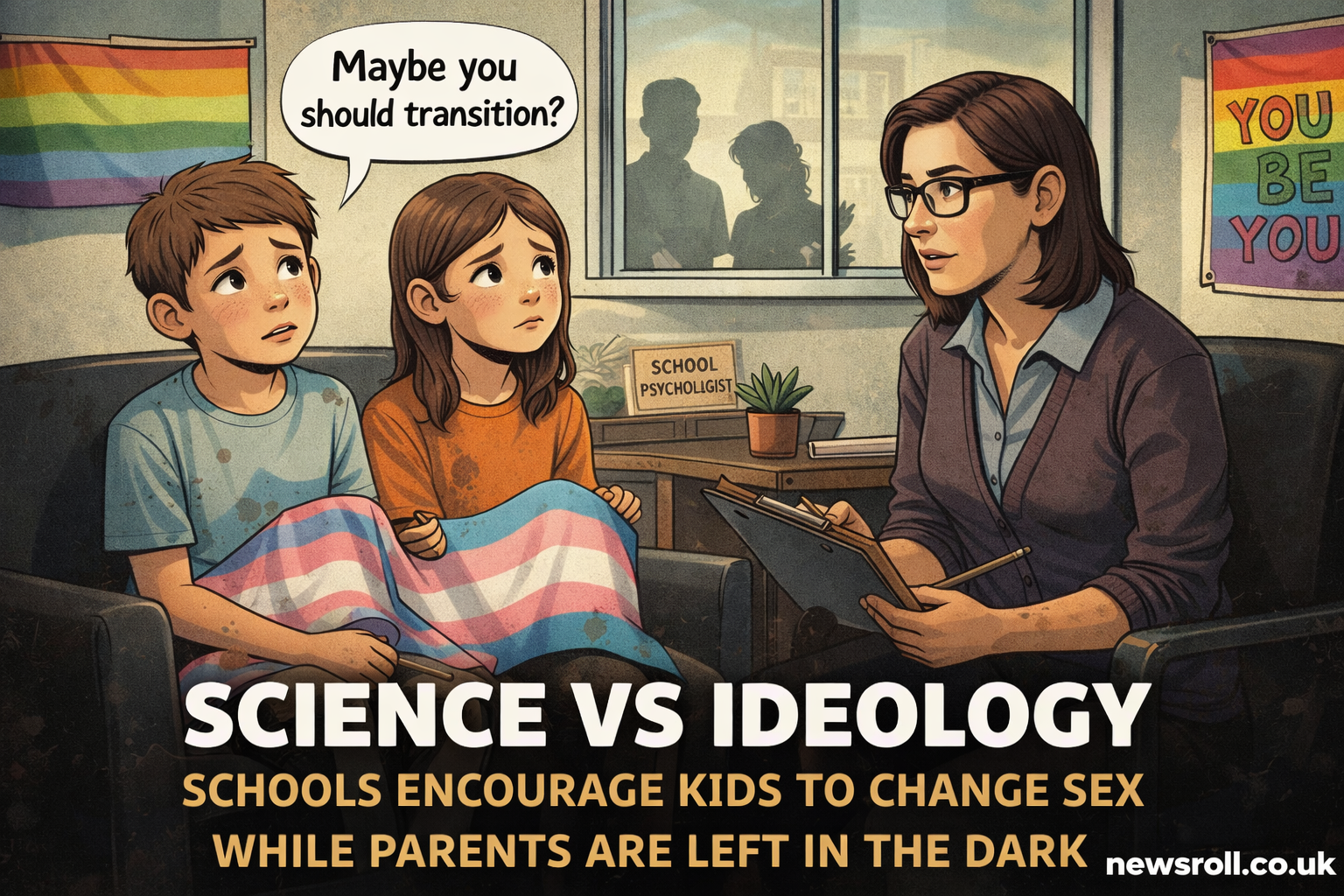
Across the United Kingdom, a growing number of parents and professionals are beginning to ask a difficult but necessary question: has ideology started to outrun evidence in the way gender identity is handled in schools?
In recent years, educational institutions have adopted increasingly assertive approaches to gender identity, often presenting complex and contested ideas as if they were settled fact. Yet the scientific and medical reality tells a different story — one of uncertainty, debate, and incomplete evidence.
This gap between policy and evidence is no longer a minor concern. It is becoming a serious safeguarding issue.
One of the most alarming aspects of current practice is the weight given to the self-declared identity of minors.
Children, by definition, are still developing — emotionally, psychologically, and cognitively. Their understanding of themselves evolves rapidly, often influenced by peers, social media, and temporary emotional states. Yet in some educational settings, their statements about identity are being treated as decisive, with immediate changes in name, pronouns, or social role.
This would be unthinkable in most other areas of life. We do not allow children to make long-term medical, financial, or legal decisions without adult oversight — yet in matters of identity, the threshold for action appears, in some cases, significantly lower.
The widespread adoption of an “affirmation-first” model — where a child’s expressed identity is immediately validated — is increasingly being questioned, including by medical professionals.
Critics argue that this approach risks short-circuiting a deeper understanding of what a child is experiencing. Feelings of discomfort, anxiety, or confusion can have multiple causes, particularly during adolescence. Reducing them to a single explanation, and reinforcing that explanation without thorough exploration, may do more harm than good.
The concern is not theoretical. It is grounded in the basic principle that complex problems require careful, evidence-based assessment — not rapid conclusions.
School counsellors and psychologists are now operating in one of the most sensitive and least clearly defined areas of modern practice.
On paper, their role is to support and guide. In reality, they are navigating a landscape shaped by policy pressure, social expectations, and incomplete scientific consensus. In such an environment, the risk of over-simplification is real.
When guidance is unclear and evidence is still evolving, the danger is that professional judgement becomes influenced by prevailing narratives rather than grounded, cautious evaluation.
This is not a question of bad intentions. It is a question of whether the system itself is pushing professionals towards premature conclusions.
Perhaps the most controversial consequence of this shift is the diminishing role of parents.
There have been increasing reports and concerns that parents are not always fully informed when their children begin to explore or adopt a different gender identity within school environments. In some cases, schools have prioritised the child’s expressed wishes over parental involvement.
This raises a fundamental issue: who is responsible for a child?
Parents are not optional participants in a child’s life. They are legally and morally accountable for their wellbeing. To sideline them in decisions with potential long-term implications is not only questionable — it risks undermining the very structure of responsibility that safeguarding depends on.
What makes this issue particularly concerning is the tone in which it is often presented.
Instead of acknowledging uncertainty, complexity, and the need for caution, the subject is frequently framed in absolute terms. Questioning current approaches can be dismissed or discouraged, creating an environment where open discussion becomes difficult.
But science does not operate on certainty where evidence is incomplete. And when it comes to children, caution is not a weakness — it is a necessity.
The stakes in this debate are exceptionally high.
If the current approach is too rigid, too fast, or insufficiently evidence-based, the consequences will not fall on policymakers or institutions — they will fall on the children themselves.
Decisions made during formative years can shape identity, mental health, and life trajectories in ways that cannot easily be reversed. This is precisely why a cautious, balanced, and evidence-led approach is essential.
Yet what is increasingly visible is a system that, in some cases, appears to prioritise immediate validation over long-term understanding.
This is not an argument against support, nor against inclusion. It is an argument against abandoning critical thinking, scientific caution, and parental involvement in one of the most sensitive areas of child development.
The United Kingdom now faces a crucial moment.
Will it continue down a path where complex issues are simplified and accelerated — or will it step back, reassess, and ensure that decisions involving children are grounded in evidence, transparency, and responsibility?
Because when it comes to children, good intentions are not enough. What matters is whether the approach is right — and whether it stands the test of time.