 11
11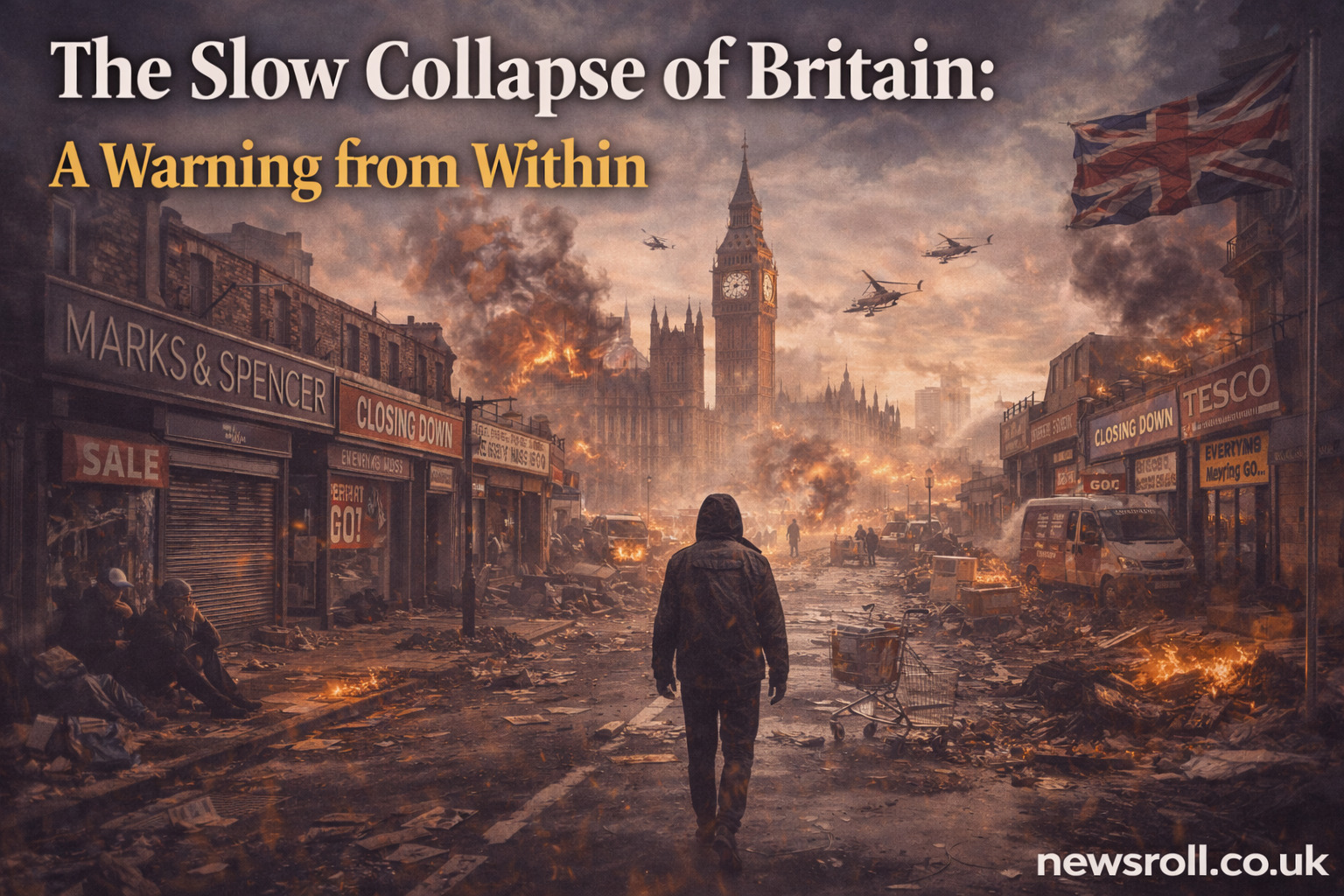
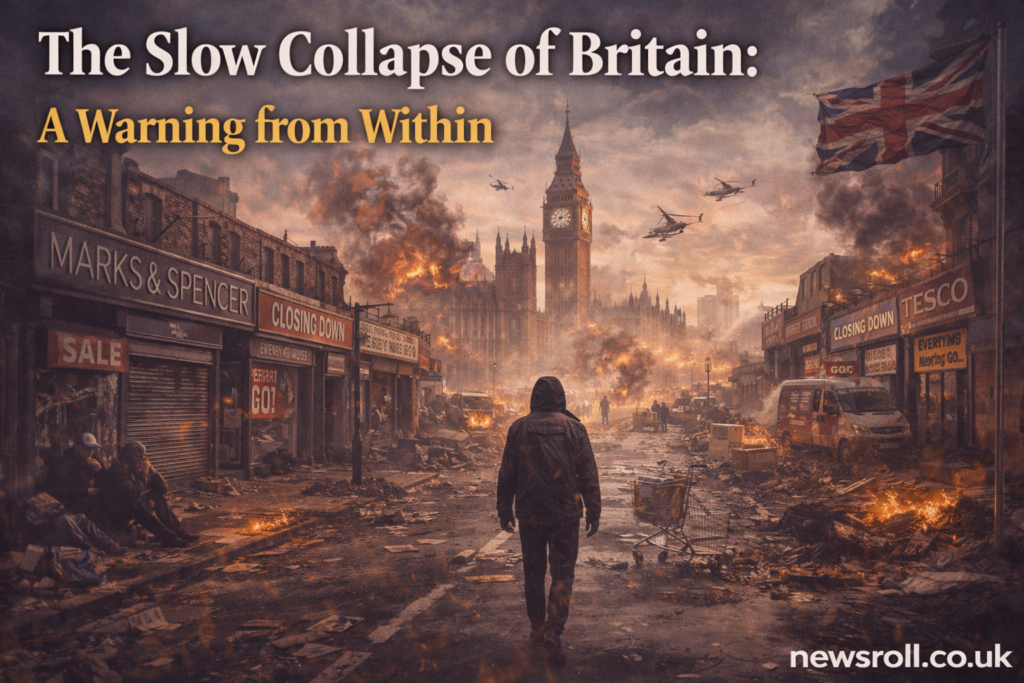
There are moments in history when decline is not announced by a single dramatic event, but by a sequence of small, interconnected failures. The United Kingdom is now entering such a moment—one defined not by collapse in the classical sense, but by a gradual erosion of stability, prosperity, and strategic relevance.
This is not speculation. It is a pattern.
In my recent book—available here: Read on Amazon UK—I explore the illusion of resilience that defines modern Western societies. Britain today exemplifies that illusion better than most. It is a country that still behaves like a global power, while increasingly lacking the structural strength to sustain that role.
The first signs are economic—and they are already visible.
The cost-of-living crisis never truly ended; it merely evolved. Inflation remains structurally embedded in the system, driven not only by internal inefficiencies but by external shocks—most notably geopolitical conflict. The war in the Middle East is not a distant event for Britain. It is a direct trigger for rising energy costs, disrupted supply chains, and renewed inflationary pressure. These forces do not operate in isolation. They compound.
Wages are no longer keeping pace. Real incomes are falling. Consumption is weakening.
And when consumption weakens, the system begins to fracture.
Retail is the first casualty. The British high street, already weakened by years of structural change, now faces something far more severe than cyclical decline. This is contraction. Large retail chains, burdened by debt, rising operational costs, and declining foot traffic, are entering a phase where survival becomes uncertain. Closures will not be isolated events—they will come in waves.
This is how economic decline manifests in the modern era: not through sudden collapse, but through disappearance.
But the economic dimension is only one layer.
The deeper issue is structural fragility. Britain has become increasingly dependent on external systems—energy imports, globalized supply chains, and international financial flows. These systems function efficiently in times of stability. In times of conflict, they break.
Food security is a prime example. The UK imports a significant portion of its food. In a prolonged global disruption, availability becomes uncertain, prices rise sharply, and social pressure intensifies. What begins as inflation becomes scarcity.
At the same time, the geopolitical environment is deteriorating.
The world is no longer unipolar. Power is shifting, alliances are fluid, and conflict is becoming more frequent and less predictable. In this context, Britain’s strategic position is increasingly exposed. Its military capabilities, while still advanced, are stretched. Recruitment challenges, delayed modernization, and limited industrial capacity raise serious questions about long-term readiness.
The uncomfortable reality is this: the UK is not prepared for a sustained global conflict.
This is not a critique—it is an observation.
Modern Britain has been shaped by decades of relative peace, economic integration, and institutional continuity. These conditions no longer exist. What replaces them is uncertainty—and uncertainty requires resilience.
Resilience that is currently lacking.
In the book I recently published, I argue that modern crises do not occur sequentially—they occur simultaneously. Energy, economy, security, social cohesion—these are not separate domains. They are interconnected systems. When one fails, it places pressure on the others. When several fail at once, the system does not collapse instantly. It degrades.
This degradation is already underway.
Public services are under strain. Trust in institutions is declining. Inequality is widening. These are not isolated issues—they are symptoms of a system under pressure. And pressure, over time, leads to rupture.
The most dangerous aspect of this process is psychological.
Societies adapt. They normalize decline. What would have been unacceptable a decade ago becomes routine. Lower living standards, reduced security, diminished expectations—these become the new baseline. Not because people accept them willingly, but because they have no alternative.
This is how decline becomes permanent.
Britain is not on the brink of immediate collapse. It is something far more complex—and more dangerous. It is entering a phase of sustained instability, where crises overlap, solutions are partial, and recovery is always postponed.
The question is no longer whether this process will continue.
The question is how far it will go.
And whether, by the time it becomes undeniable, there will still be the capacity—or the will—to reverse it.