 11
11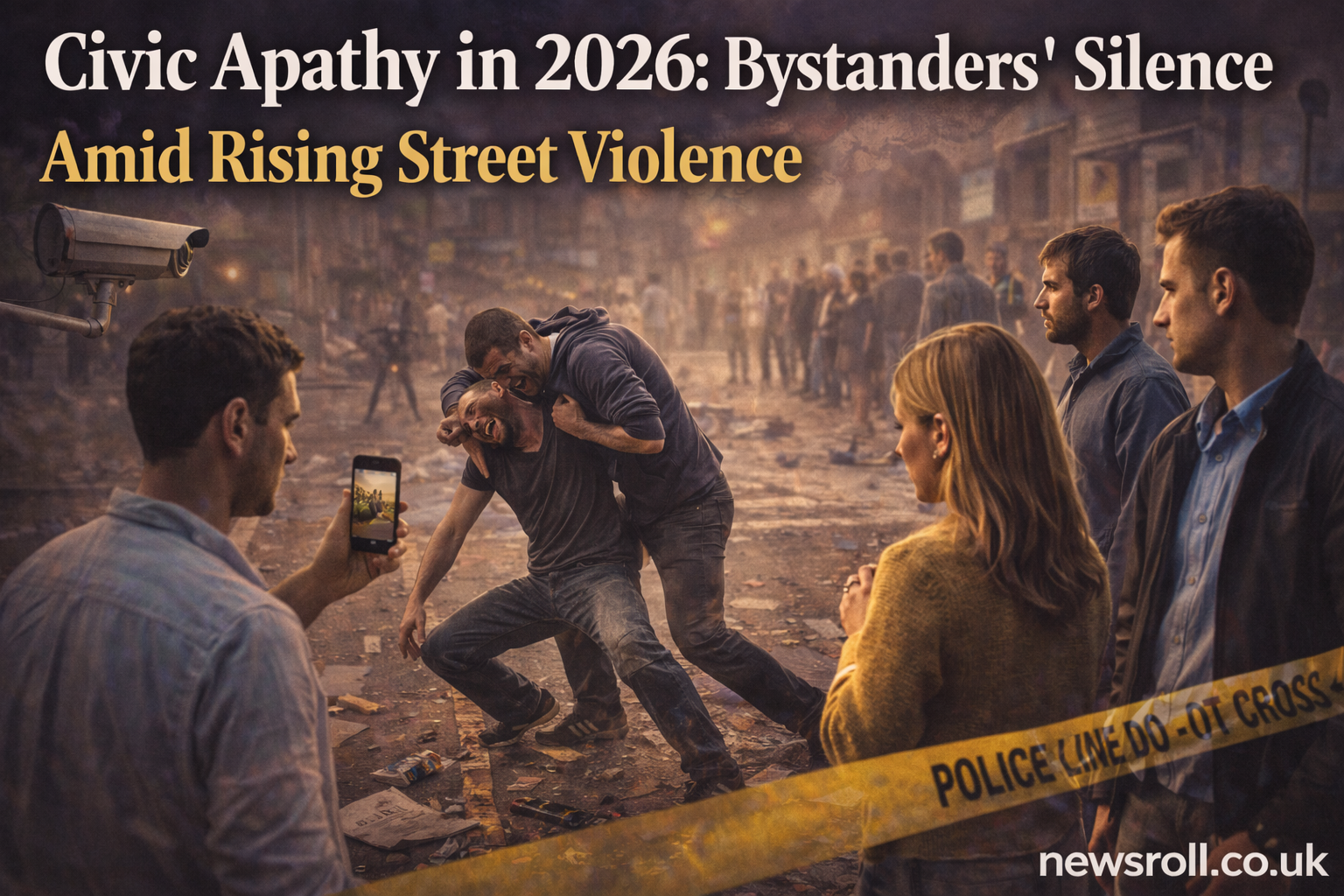
In recent years, the United Kingdom has seen a growing number of incidents of street violence, many of which have sparked not only concern about public safety but also deeper questions about social responsibility. Beyond the acts themselves, one recurring and troubling pattern stands out: the silence of bystanders.
Videos circulating online frequently show assaults taking place in public spaces—on high streets, public transport, or outside nightlife venues—while those nearby watch, record, or walk away. In some cases, dozens of witnesses are present, yet few intervene. This phenomenon, often described as “bystander apathy,” is not new, but its visibility has increased significantly in the age of smartphones and social media.
Several factors contribute to this growing detachment. Fear is perhaps the most immediate. Many people are reluctant to intervene in violent situations due to concerns for their own safety. With rising reports of knife crime and unpredictable street altercations, the perceived risk of stepping in can outweigh the instinct to help.
At the same time, there is a broader erosion of civic responsibility. The sense that individuals share a collective duty to protect one another in public spaces appears to be weakening. Instead, there is a growing tendency to see incidents as someone else’s problem—something for the police or authorities to handle, rather than ordinary citizens.
Technology has also played a role. The instinct to record rather than respond reflects a shift in behaviour shaped by social media culture. Capturing an incident can feel like participation, even if it does nothing to assist the victim. In some cases, footage may later aid investigations, but in the moment, it often replaces more immediate forms of help.
There is also the psychological dimension known as the “bystander effect,” where individuals are less likely to intervene when others are present. Responsibility becomes diffused, and each person assumes someone else will act. In crowded urban environments, this effect can be particularly pronounced.
Authorities and campaign groups have begun to address the issue, promoting awareness around safe intervention. Initiatives encourage people to take indirect action—such as calling emergency services, drawing attention to the situation, or supporting the victim after the incident—rather than engaging physically with an aggressor. These approaches aim to rebuild a sense of civic engagement without putting individuals at undue risk.
However, critics argue that deeper structural issues are at play. Cuts to community policing, reduced visible presence of law enforcement, and broader social inequalities may all contribute to an environment where violence is more likely and public confidence in intervention is lower.
The consequences of widespread inaction are significant. When violence occurs without resistance—whether from authorities or the public—it risks becoming normalised. Public spaces, once seen as shared and relatively safe, begin to feel uncertain and fragmented.
Addressing this issue requires more than policy changes. It calls for a cultural shift—one that reaffirms the idea that public safety is a shared responsibility. While no one should be expected to put themselves in harm’s way, the complete absence of response reflects a deeper social disconnect.
As the UK continues to grapple with rising concerns about crime and safety, the question is no longer just about how to prevent violence, but also about how society chooses to respond when it happens. In that response lies a measure of collective values, and perhaps the direction in which those values are heading.